
In May, Google made an announcement that should be on the radar of every coach and consultant who relies on being found online.
At Google I/O (the annual developer conference) on 19 May, Google made clear that AI-powered search is now central to its future direction, with AI Overviews expanding significantly and AI Mode becoming a major part of the search experience. Two days later, the May 2026 core update started rolling out, the second major ranking update of the year, completing on 2 June.
If that feels like a lot happening at once, you’re right, and here’s what it actually means for your business.
What Google Just Changed
There are two main things worth knowing.
1. AI Overviews and AI Mode are now one experience
Google is now combining AI-generated search summaries with a more conversational experience, so a potential client can ask a question, get an AI answer all without leaving the search results page.
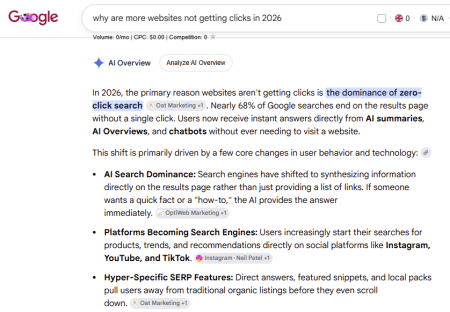
Some results also suggest follow-up questions beneath the AI summary, inviting you to keep the conversation going rather than click through to a website.
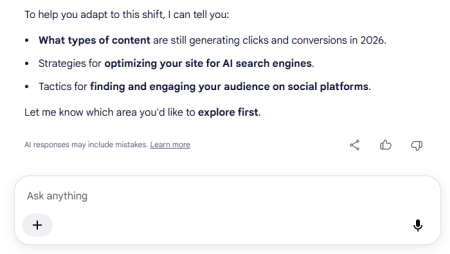
Not every Google search triggers an AI-generated summary, but the conversational, question-based searches your ideal clients make when they’re looking for help? Those are among the most likely to. Searches containing seven or more words are seven times more likely to trigger an AI Overview.
2. Search is becoming more conversational
People are no longer searching using short keyword phrases alone. They’re asking full questions, refining those questions, and expecting AI-generated answers that feel more like a conversation than a list of links. Google is signalling that the traditional search box is evolving into something much more conversational and AI-driven.
That changes how expertise gets discovered online.
What this means in practice for coaches, consultants and small businesses
If you’ve ever wondered why you’re creating content consistently but still aren’t getting the enquiries you expected, these changes make that question even more important.
You may already be familiar with AI Overviews – those AI-generated summaries that appear above the search results. One of my clients has a blog post sitting at position 1 on Google.
It generated more than 13,500 impressions last month but had zero clicks.
The answer was being delivered directly inside Google’s AI-generated results before anyone needed to visit the website. That’s no longer an edge case. It’s the direction everything is heading.
A potential client searching for a business coach, a consultant in their niche, or someone who solves the exact problem you solve, they may now get an AI-generated answer that never sends them to any website at all.
The question is whether that answer includes you.
What the May core update actually means
The May core update finished rolling out on 2 June. Google described it as a standard update designed to better surface relevant, satisfying content. No new rules, no new systems, the same principles that have always applied:
“helpful, people-first content written for real human beings”
What a core update does is reassess who best demonstrates those principles, and in an AI-first search environment, that reassessment is increasingly weighted towards genuine expertise, clear positioning, and content that actually answers questions rather than just describes services.
If your content has already been built around your audience’s real questions and your authentic expertise, the chances are you are still in good shape.
One practical note on your Search Console data: the May core update completed on 2nd June, and the dust has now settled. If you haven’t already, now is a good time to compare your traffic and impressions data against the weeks before the update rolled out. Any significant changes you’re seeing are likely a genuine signal worth paying attention to instead of rollout volatility.
Three things worth doing now
You don’t need to overhaul everything. But these three things are worth turning your attention to.
Check how you actually show up.
Open Google, ChatGPT, Gemini or Perplexity and ask the kinds of questions your ideal clients would ask when they’re looking for someone like you.
- Best business coach for [your niche]
- Who helps with [problem]
- Top consultants for [specialism]
What comes back? Is your name there, or are your competitors being recommended instead? This takes ten minutes and tells you more about your current visibility than most analytics reports.
Make sure your website answers real questions.
Not just “here are my services” but genuinely helpful content that addresses what your ideal clients are searching for. Google has been saying this for years and in an AI-first search environment, it matters more than ever.
Look beyond your website.
Social media platforms, podcast appearances, guest articles, directory listings, third-party mentions – these all feed the AI recommendation engine. AI systems don’t just look at your website. They also pay attention to what other credible sources say about you.
What this means for your visibility strategy
If your visibility strategy begins and ends with your website, there’s a good chance you’re missing the places your ideal clients are actually looking.
Search & AI Visibility is about making sure that when a potential client is looking for what you do, whether they’re typing into Google, asking ChatGPT, or using another AI-powered search tool, your name, your expertise, and your positioning are part of the answer. No matter the type of business you run, the same principles apply.
The question isn’t whether AI search is changing. It already has.
The real question is whether your expertise is part of the answers people are now being shown.
If you’re not sure, that’s exactly what the Client Attraction Audit is designed to uncover.
Author Bio
Angie Stewart helps coaches, consultants and service-based professionals attract the right clients by clarifying their positioning, messaging and visibility in AI-powered search. Her approach combines practical strategy, real-world experience and human-led, AI-supported marketing.
Leave A Comment