
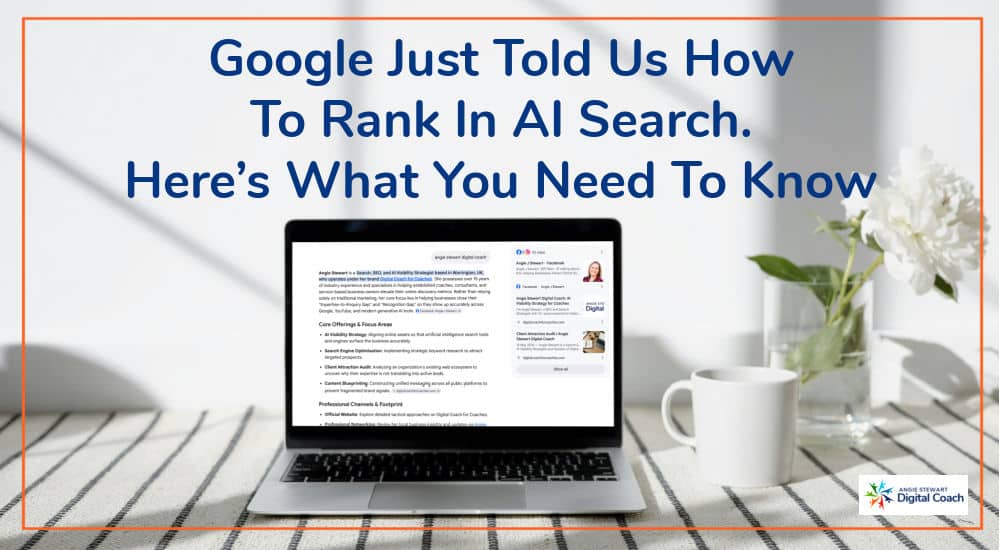
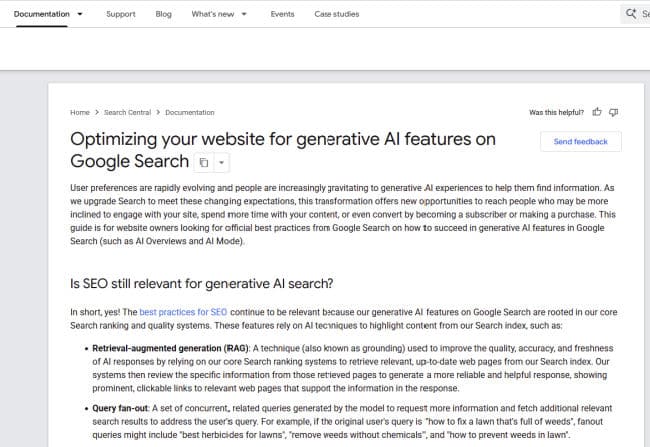
Google has published its first official guide on how websites can appear in AI-powered search results, specifically AI Overviews and AI Mode. These are the features that are increasingly answering questions directly at the top of search before a user clicks a link.
It’s worth paying attention to.
Not because everything has changed, but because Google has been unusually direct about what works, what doesn’t, and what you can stop wasting time on.
Here’s what business owners need to know.
The Most Important Thing Google Has Said
AI search and regular search are not two separate systems. Google’s AI pulls its answers from the same index it has always used, the same one your website has always been trying to rank in.
That means there isn’t a completely separate AI game to play. The businesses appearing in AI results are usually the same ones already building strong visibility, authority, clarity and trust.
If your SEO has been neglected, that’s still the place to start.
What Google Actually Rewards
Content only you could write.
This is the big one. Google is drawing a clear line between what it calls “commodity content,” generic advice that could come from anywhere, and content built on genuine expertise or first-hand experience.
Think about the difference between
1) “5 signs you need a business coach” and
2) “Why experienced coaches and consultants often struggle to explain their value online, even when they’re excellent at what they do.”
The first could be written by anyone, whilst the second comes from someone who understands the real problem.
If your content simply repeats what already exists elsewhere online, AI systems may summarise the information without needing to reference your business directly. The more your content reflects real experience and specific knowledge, the more valuable it becomes.
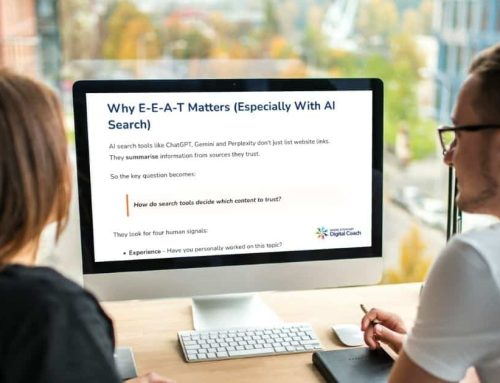
Much of Google’s guidance still points back to the same core principles behind E-E-A-T: real experience, genuine expertise, trust, and helpful content created for humans first.
AI systems also look for consistency: consistent expertise, consistent messaging, and consistent signals about who you help and what you’re known for.
A website Google can actually read
Your pages need to be crawlable, indexed, and technically sound. If Google can’t find and process your content, no amount of good writing will help. This means a clean site structure, decent page speed, and no technical barriers blocking search engines.
For most businesses, this isn’t glamorous work, but think of it like the foundations of a house. No one is particularly interested in the concrete base, but without it, nothing above ground holds up. Get this right first, and everything else you build on top of it is far more likely to perform.
Not sure if Google can actually find your site? Here’s a quick way to check.
Up-to-date business and product listings
For local businesses and retailers, an important foundation is making sure your Google Business Profile and Google Merchant Centre listings are complete and up to date. Google is increasingly using these to populate AI responses directly, meaning incomplete or outdated information isn’t just a missed opportunity, it’s a gap in your foundations.
AI Visibility Is No Longer Just About Clicks
If you’ve noticed your impressions holding steady or even growing in Google Search Console, but your clicks have quietly dropped, this is AI search in action.
People are increasingly getting partial answers directly on the results page, without needing to visit a website at all. That changes the way visibility works.
Your business can now appear in AI summaries, influence buying decisions, build familiarity, and become part of someone’s research process long before they’ve ever landed on your site. In many ways, search is becoming a pre-selection engine. Buyers are forming opinions and shortlisting options earlier in the journey than ever before.
One of my clients has a blog post sitting at position 1 in Google with over 13, 500 impressions in the last 30 days, with zero clicks. AI search is answering the question before anyone needs to visit the page.
Another signal worth watching is branded search. People searching directly for you using your business name. An increase in brand searches often indicates that AI is surfacing your business during the research phase and prompting people to look you up directly. It’s one of the clearest signs that your visibility is working, even when clicks from generic searches are down.
That makes consistent visibility more important, not less. Businesses who are clearly understood by AI systems: what they do, who they help, and why they’re credible are far more likely to to be the name that comes to mind when it’s time to make a decision.
It’s one of the reasons I have developed the Expertise-to-Enquiry Gap Framework, a structured approach to building the kind of online presence that performs whether someone clicks through immediately or not.
What You Can Stop Worrying About
It is refreshing to see Google be unusually blunt here.
My Honest Takeaway
The businesses that will do well in AI search are the ones that genuinely know their subject and are willing to demonstrate it clearly online. That’s not a new idea, it’s what good content marketing has always been about.
AI can now produce generic, recycled content instantly. Make yours stand out from the crowd by bringing real insight, real experience, and a genuine point of view.
If your website reflects things you’ve actually learned from working with your customers, you’re in a far better position than you might think.
If it’s mostly full of content copied and rehashed from elsewhere, it is probably the time to strip it back and let your real expertise do the talking.
You can read Google’s full guide here: Optimizing your website for generative AI features on Google Search
If your expertise isn’t translating into consistent enquiries online, there’s usually a reason. The problem is rarely effort, it’s clarity, positioning, visibility, or trust signals breaking down somewhere in the journey.
That’s exactly what the Client Attraction Audit is designed to diagnose.
Author Bio
Angie Stewart helps coaches, consultants and service-based professionals attract the right clients by clarifying their positioning, messaging and visibility in AI-powered search. Her approach combines practical strategy, real-world experience and human-led, AI-supported marketing.

Leave A Comment