
If you’ve been creating content for your website, or exploring how AI can support your marketing, you may have come across the term E-E-A-T.
And if it sounded technical, overwhelming or “too SEO”, you’re not alone.
The good news?
E-E-A-T is simple.
And once you understand it, writing blogs that reflect your voice, share your authentic insight and speak clearly to your ideal client becomes much easier.
This guide explains E-E-A-T in plain language and shows how you can immediately apply it to your blogs.
In This Guide
Published: 16th January 2026
Quick Answer (Key Highlights)
E-E-A-T stands for Experience, Expertise, Authority and Trust.
These are the human signals Google and AI search tools use to understand whether your content is reliable, helpful and worth showing to people.
E-E-A-T isn’t technical, it’s simply how search tools decide
- if your content comes from someone who genuinely understands the topic.
- whether the information is trustworthy
- whether it should be summarised or shown in Google search results or within AI responses
You strengthen E-E-A-T by adding small pieces of lived experience – real examples, client insights and interactions, lessons learned, and simple, clear explanations written in everyday language.
You don’t need to overthink this.
Even one or two sentences make a meaningful difference.
Before We Go Further – A Quick Reassurance
If SEO terms usually make things feel more complicated than they needs to be, you can relax here.
This is not a technical framework, it’s a simple way to ensure your real-world insight shines through, so the right people find you.
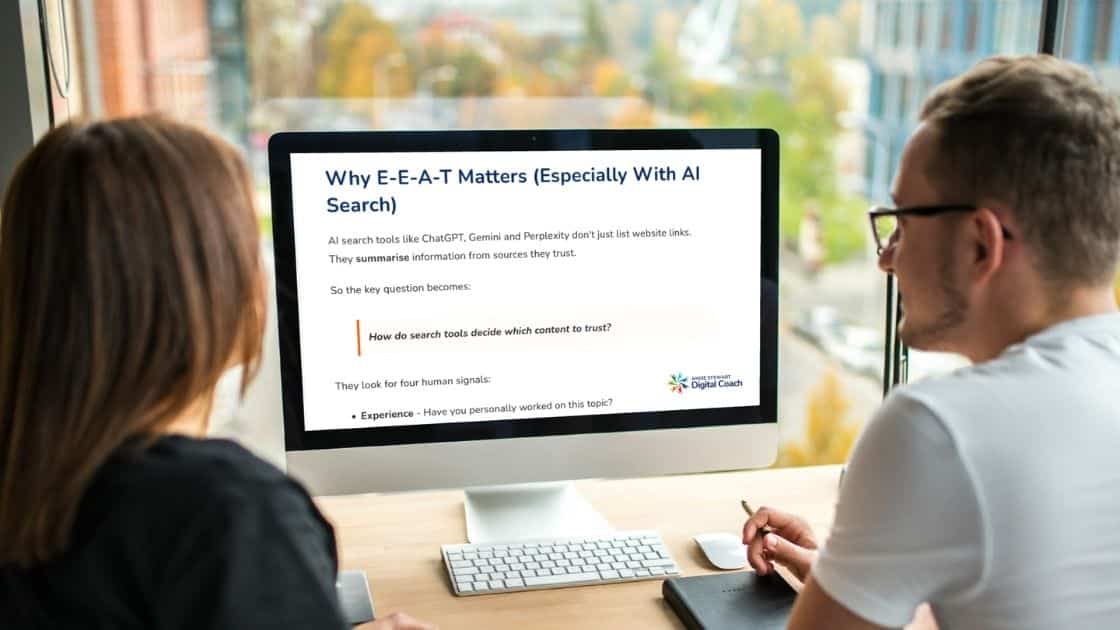
Why E-E-A-T Matters (Especially With AI Search)
AI search tools like ChatGPT, Gemini and Perplexity don’t just list website links.
They look for clues that content comes from a real, reliable source.
So the key question becomes:
What helps search tools recognise trustworthy content?
They look for four human signals:
- Experience – Have you personally worked on this topic?
- Expertise – Do you have knowledge, training or skill in it?
- Authority – Are you recognised or consistent in your field?
- Trust – Is your content clear, honest and reliable?
These signals come directly from Google’s E-E-A-T guidelines, and AI tools now use the same approach.
Here’s the most important point:
AI can generate text – but it cannot generate your lived experience.
Your stories, insights and personal perspectives are the signals that set your content apart.
What Is E-E-A-T In SEO? (Explained Simply)
In SEO, E-E-A-T is how Google understands whether content is trustworthy and worth showing.
It isn’t a formula or a score, it’s simply Google asking:
- “Is this written by someone who understands the topic?”
- “Is this genuinely helpful?”
- “Does this reflect real experience?”
When AI search engines scan your content, they look for the same signals.
This is why adding clear examples and insight helps your content show up more often, both in Google and in AI-generated answers.
What E-E-A-T Actually Means (Your Simple E-E-A-T Framework)
1. Experience (Your Lived Experience)
This is the most important part.
Experience answers the question: “Have you actually done this?”
Examples include:
- insights from client work
- lessons learned by doing
- mistakes people commonly make
- something you discovered early on
Just one sentence can demonstrate experience.
2. Expertise (Your Knowledge or Skill)
Expertise includes:
- training
- qualifications
- your approach or method
- your ability to explain concepts clearly
You don’t need to be the biggest expert, just someone who demonstrates real understanding.
3. Authority (Credibility Built Over Time)
Authority grows through:
- consistent content
- speaking, training or teaching
- clear client results
- well-structured explanations
Authority is built slowly and naturally.
4. Trust (Honesty, Clarity and Transparency)
Trust is created by:
- writing clearly
- keeping your language simple
- using real examples
- being transparent about your experience
- focusing on being helpful, not impressive
Trust is the final layer that makes your content easier to engage with.
How Is E-E-A-T Measured?
It isn’t!
Google doesn’t score you or assign a rating.
Instead, search tools look for signs that a real person, with real experience wrote the content:
- examples
- insights
- lessons
- client stories
- a clear author bio
- accurate, straightforward explanations
If these signals are present, your E-E-A-T is strong.
Clarity First: The Foundation Of Strong E-E-A-T
E-E-A-T becomes much easier when you’re clear about:
- who you’re speaking to
- what they care about
- the problem you solve
- the message you want to share
- the transformation you offer
When you have clarity, your lived experience connects naturally to your content.
Your writing becomes more confident, aligned and easier to create.
This is why my work always begins with clarity.
Clarity → Confidence → Consistency → Visibility.
How To Improve E-E-A-T (Simple Tips You Can Use In Every Blog)
Mini Summary
E-E-A-T isn’t technical.
It’s simply a way to show:
- what you’ve done
- what you know
- how you help
- why your content can be trusted
In a world where AI can be used to effortlessly generate endless content, your real experiences are the human elements that truly set you apart.
FAQs
Do I need qualifications to show expertise?
No. Lived experience is equally valuable.
Do I need long stories?
No. Short examples are enough.
Does E-E-A-T help with SEO?
Yes. Search tools use E-E-A-T to decide whether your content is trustworthy.
Can AI create E-E-A-T for me?
No. AI can tidy your writing, but the experience must come from you.
What To Do Next
If you want E-E-A-T to feel natural, and you want your blogs to reflect your voice, insight, and your ideal client’s real needs — the first step is clarity.
That’s exactly what the Client Attraction Audit is designed to support.
It helps you clarify your positioning, messaging, and priorities, so your content stops feeling vague, overwhelming, or inconsistent.
Once that foundation is clear, creating content that works well for both people and AI becomes much simpler.
Author Bio
Angela Stewart is a digital marketing specialist who helps coaches, consultants and service-based small business owners attract clients through human-led, AI-supported content and simple clarity-first marketing strategies.



[…] Previous 10 E-E-A-T Content Prompts to Add Authentic Human Insight to Your Blogs […]